

Toronto Digitization Company Responds to Declining Availability of Analog Transfer Equipment
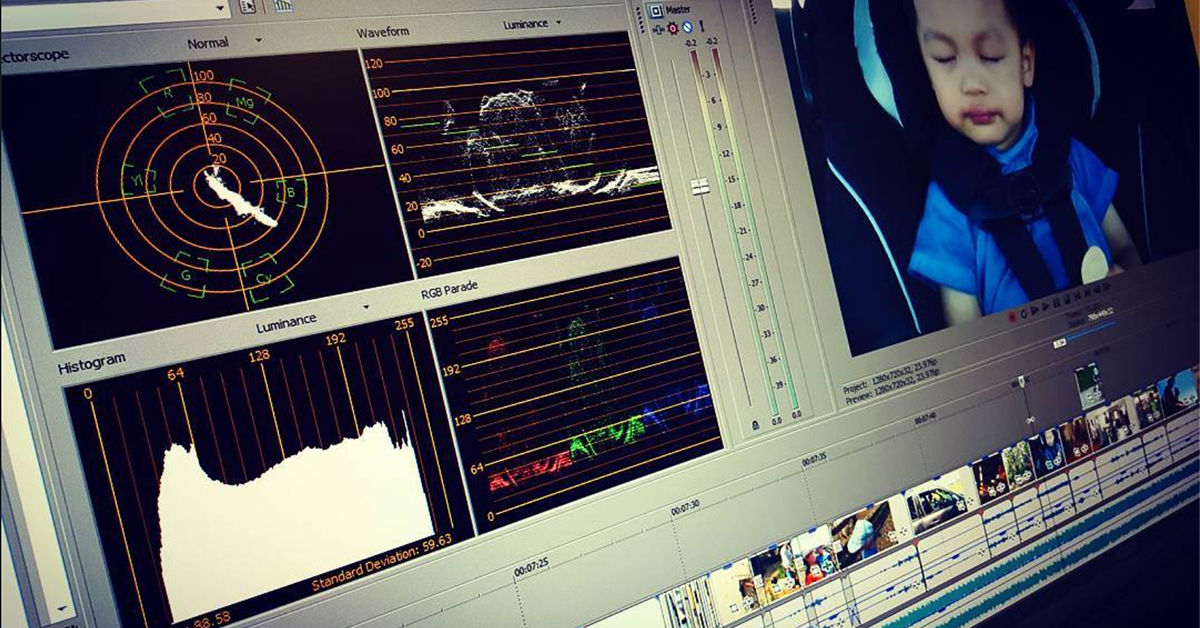
Reviewing the Vector Scopes
As equipment to read old tapes becomes scarce, a Toronto company warns families: your window to digitize analog memories is closing fast.
What's changing is our ability to service them. Replacement parts for playback decks are becoming more challenging.”
TORONTO, ONTARIO, CANADA, January 5, 2026 /EINPresswire.com/ -- For nearly two decades, Azure Production has transferred analog footage into digital formats for thousands of clients, including TD Bank, the Government of Ontario, and the City of Toronto. But according to the company's founder, the real crisis isn't tape deterioration, it's the disappearing decks and machines needed to read them.— The Founder
"We're seeing a 98% success rate on tape transfers right now," explains the founder of Azure Production. "The tapes themselves, if stored properly in a climate-controlled environment, are often in surprisingly good condition. What's changing is our ability to service them. Replacement parts for playback decks are becoming more challenging. Technicians who understand this equipment are retiring and the industry trend is declining. The question isn't whether your tapes will survive another decade, but I believe it's whether anyone will have the tools to read them."
This equipment scarcity creates a narrow window of opportunity. Azure Production maintains several transfer stations, each representing a handsome penny in specialized hardware where most of them is no longer manufactured. Their workflow includes increasingly rare components such as Time Base Correctors that stabilize unstable analog signals, and video capture hardware. When a deck fails, replacement becomes a hunt on online classified posts and estate sales just to name a few, that is why they typically store older machines at their remote studio to swap out parts.
The company stands in contrast to the AI upscaling services that promises to transform grainy home videos into 4K masterpieces. "We currently and deliberately don't use AI enhancement," the founder states. "VHS has a horizontal resolution of roughly 240-250 lines. Real 4K has 3,840 horizontal pixels. You can't artificially invent details that were never captured. What we offer is the highest-fidelity preservation of what actually exists on your tapes."
This philosophy extends to their controversial "broadcast safe" transfer standard, which some clients initially perceive as producing "flat" or "dull" results. The founder clarifies in his technical terms: "About one in ten clients requests our more vivid REC709 colour space option. But broadcast safe transfers preserve maximum information for future editing considerations, similar to LOG footage from professional cameras. We're prioritizing data preservation over immediate visual impact. When your grandchildren watch footage of their great-grandparents fifty years from now, they'll have the most authentic experience of the original format possible."
The emotional weight of this work carries all the way down to the customer. Once the videos are transferred, the founder was told by many of his clients that families gathered around their living room to watch their home movies with love and tears. In one heartbreaking case, a client brought in a film reel from the early 1900s that had completely disintegrated, rendering them unrecoverable.
Azure Production's process reflects their two-decade expertise. Before any transfer begins, technicians inspect tapes for mold, sticky shed syndrome, warped and broken casings. They clean playback heads often due to contamination as thin as oxidation residue creates dropouts and signal loss. Unlike budget services, they aim for a single, careful capture to minimize mechanical stress on aging media. Each tape receives individual attention: adjusting the luma level, calibrating the colour saturation, setting audio to proper levels to prevent clipping, and applying professional noise reduction processes are standard practices.
The company captures in Apple ProRes formats which has a bitrate of approximately 30 Megabits per second (Mbps)—six times the equivalent bitrate of analog video—ensuring digitization itself doesn't introduce compression artifacts. They then export to the popular MP4 format and verify the beginning, middle, and end of each file for anomalies.
For families sitting on closets full of VHS, 8mm, film or Betamax tapes, the message is clear: proper storage in non-humid, temperature-stable environments has likely preserved your footage. But the machines and expertise to retrieve those memories are vanishing. The best time to digitize was five years ago. The second-best time is now—before the equipment itself becomes a museum piece.
While Azure Production doesn't currently offer AI upscaling due to insufficient demand, the founder remains open to adding this service if client needs evolve. For now, their focus stays on what they do best: preserving authentic memories before the last generation of transfer equipment disappears entirely.
C.I. Chow
Azure Production Inc.
+1 416-850-7976
email us here
Visit us on social media:
Instagram
Facebook
YouTube
X
How We Transfer Your Home Movies To Digital
Legal Disclaimer:
EIN Presswire provides this news content "as is" without warranty of any kind. We do not accept any responsibility or liability for the accuracy, content, images, videos, licenses, completeness, legality, or reliability of the information contained in this article. If you have any complaints or copyright issues related to this article, kindly contact the author above.
