

NordSpace Awarded DND IDEaS Funding to Advance VLEO Satellite for Ultra High-Resolution SDA and D2D Connectivity
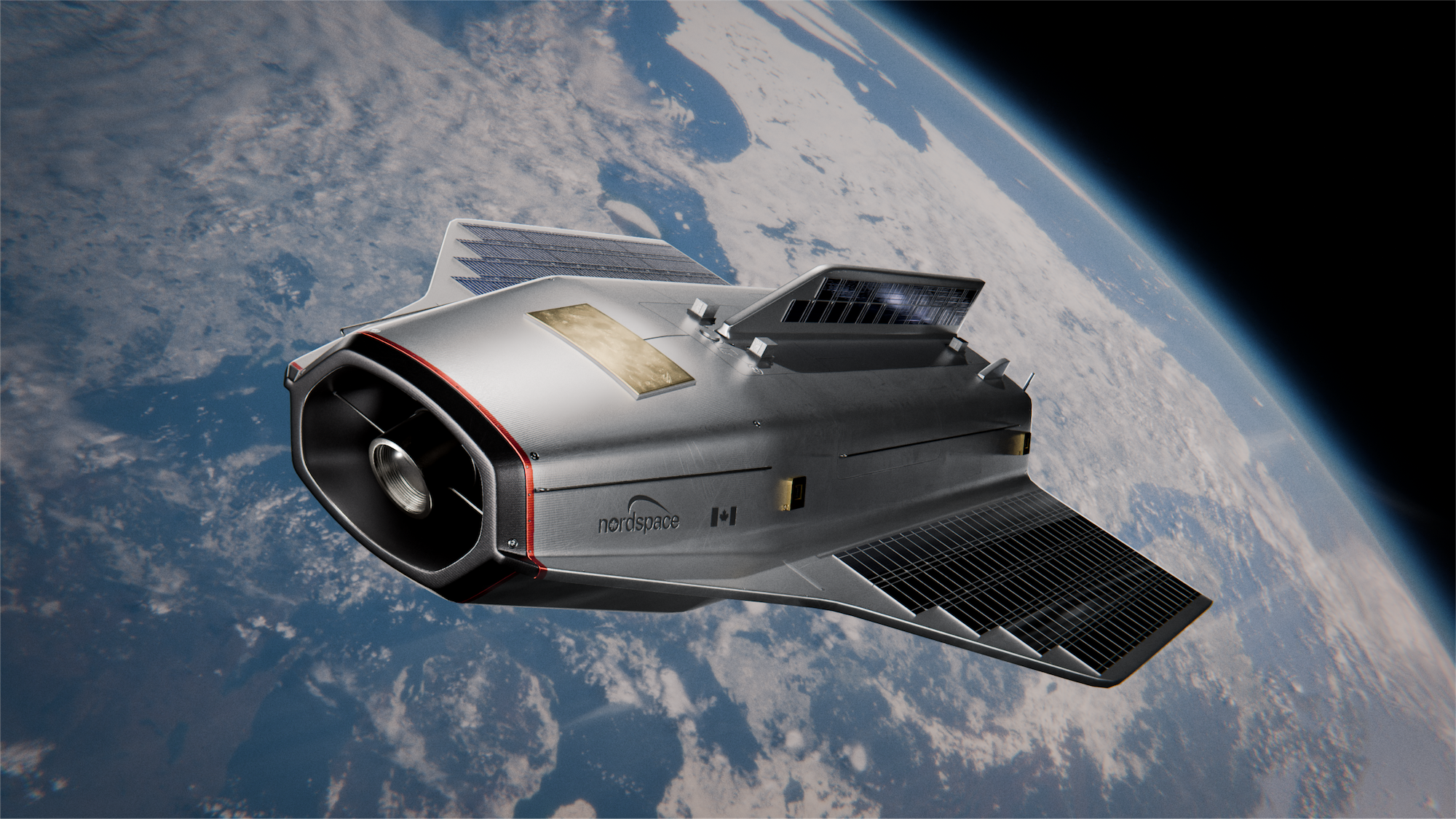
NordSpace - VLEO "Kestrel" Satellite Concept
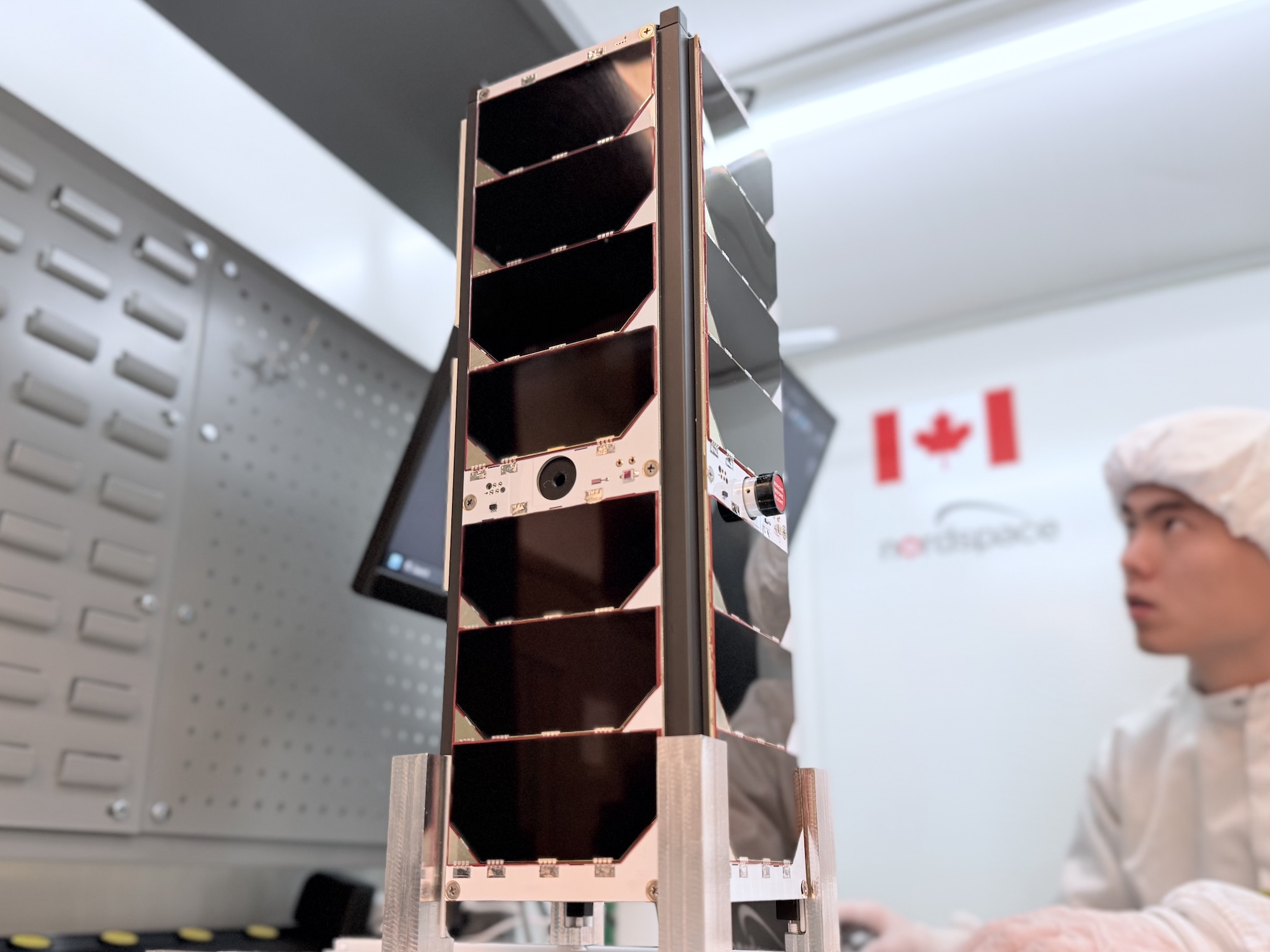
NordSpace - Terra Nova Satellite in Clean Room
NordSpace is laying the groundwork for a future operational responsive constellation of satellites to develop an end-to-end space missions capability in Canada.
Through this IDEaS Competitive Projects Phase 1 award, NordSpace will mature key technologies for a constellation consisting of its previously undisclosed VLEO satellite concept named "Kestrel". The project focuses on architecture and payload concepts that enable extended broadband coverage, improved link budgets, and reduced latency compared to higher-orbit constellations, while remaining compatible through direct-to-device (D2D) systems with standard 5G mobile networks and IoT devices.
Crucially, NordSpace is using this phase to lay the groundwork for a future operational responsive VLEO constellation of Kestrel satellites targeting daily 10 cm spatial resolution imaging and markedly lower latency as part of its medium-term goals to develop an end-to-end space missions capability in Canada. This future state aims to fuse ultra–high resolution Earth observation and space domain awareness (SDA) of LEO assets with real-time data downlinks enabling richer situational awareness and more responsive connectivity for defence, public safety, and remote users than legacy systems can provide. Launching this constellation from NordSpace’s orbital class rockets and dedicated spaceport, the Atlantic Spaceport Complex (ASX) in Newfoundland and Labrador, will deliver on the company’s strategic goals for internalized launch demand and cadence, as well as a truly sovereign space missions capability for Canada.
Canada's Defence Industrial Strategy identified SDA as a sovereignty priority, with NORAD modernization pulling cislunar custody into scope. A domestic VLEO asset like NordSpace's Kestrel fits that gap uniquely well: sitting below the debris belt and above the bulk of the atmosphere, a maneuverable VLEO platform can deliver persistent custody of objects from LEO to HEO to cislunar space, a capability that ground sites cannot match. NordSpace’s concept directly addresses IDEaS’ essential outcome of enabling operations in remote, unserved, and underserved regions, as well as in scenarios where terrestrial infrastructure is damaged or overloaded by disasters or crises. In particular, the VLEO architecture is being shaped around use cases such as Arctic operations, wildfire detection and response, and maritime and remote land operations where uninterrupted, interoperable communications are critical for DND/CAF and public safety partners.
“Non-terrestrial networks are transforming how we think about coverage, resilience, and interoperability, evidenced by systems like SpaceX’s Starlink” said Rahul Goel, Chief Executive Officer of NordSpace. “By iterating quickly from our Space Systems Lab to on-orbit demonstrators, we can help DND/CAF and public safety agencies stay ahead of threats, maintain communications in the harshest conditions, and better protect Canadians at home and abroad. As the industry moves toward future constellations with 10 cm ultra-high-resolution imaging and low-latency direct-to-device links, we see a clear path to a new generation of space-enabled situational awareness and command-and-control. Launching constellations of small VLEO Kestrel satellites from our own launch vehicles and our own spaceport will result in the truly capable sovereign space missions capability Canada lacks, and a self-sustaining scalable commercial enterprise.”
This IDEaS award builds on NordSpace’s Space Systems Lab (SSL), which was launched in 2025 to expand the company from launch vehicles and spaceport infrastructure into complete spacecraft and on-orbit sensing capabilities. As the Lab’s inaugural program, NordSpace is manifesting Terra Nova, a self-funded, dual-use defence and commercial demonstration satellite scheduled to launch on SpaceX’s Transporter mission in 2026, which serves as a pathfinder for future constellations operated from Canadian soil.
The SSL provides in-house test capabilities including a thermal vacuum facility, vibration test facility, clean rooms and more, and is led by engineers with experience from Canadian and international space organizations such as MDA Space, NASA JPL, UTIAS SFL, Firefly Aerospace, SpaceX, and Rocket Lab. These capabilities allow NordSpace to iterate rapidly on spacecraft platforms and payloads, giving the IDEaS-sponsored VLEO constellation technologies a direct route from concept to on-orbit demonstration.
NordSpace is developing a vertically integrated model that spans launch vehicles, spaceport infrastructure, satellites, and downstream data and connectivity services. Terra Nova and subsequent SSL missions provide an in-orbit testbed for electric propulsion, payload technologies, and operational concepts that can be directly repurposed for a future VLEO NTN and EO constellation.
By linking its launch capabilities with on-orbit infrastructure, NordSpace aims to reduce the cost and schedule risk associated with deploying and replenishing large constellations in low Earth orbits. This approach allows defence and public safety customers to treat space connectivity as an agile, rapidly upgradable layer of their communications architecture, instead of a static asset locked into long replacement cycles.
About NordSpace
NordSpace, a 100% Canadian-owned aerospace defence company established in 2022, develops vertically integrated solutions for responsive orbital launch vehicles, spaceports, turn-key satellites, and mission-critical software systems. 100% designed, built, and flown in Canada to go from anywhere on Earth to anywhere in space. The company’s mission is to advance life on Earth through space, delivering innovation, jobs, national security, and sovereignty.
Jennifer Gawor
NordSpace Corp.
contact@nordspace.com
Visit us on social media:
LinkedIn
Instagram
YouTube
X
Legal Disclaimer:
EIN Presswire provides this news content "as is" without warranty of any kind. We do not accept any responsibility or liability for the accuracy, content, images, videos, licenses, completeness, legality, or reliability of the information contained in this article. If you have any complaints or copyright issues related to this article, kindly contact the author above.
